Operational Continuity &
Decision Intelligence
How AstraSense supports organisations navigating complex, dynamic, and uncertain environments — from critical infrastructure to public sector resilience.
Executive Summary
AstraSense is an operational continuity and decision intelligence platform designed to help organisations maintain effective operations in complex, dynamic, and uncertain environments. It exists because the conditions under which critical decisions are made have fundamentally changed — and the tools available to decision-makers have not kept pace.
Across government, critical infrastructure, public services, and enterprise operations, organisations face an expanding set of challenges: information arriving faster than it can be processed, operational environments that shift without warning, and decisions that carry significant consequences for communities, assets, and continuity of service.
AstraSense addresses these challenges by providing a structured environment for situational awareness, operational assessment, and decision support — designed to be trusted, traceable, and accountable.
“AstraSense does not replace human judgement. It supports it — by ensuring that the people responsible for critical decisions have access to coherent, contextualised, and reliable information when it matters most.
This white paper outlines the problem space AstraSense was built to address, the principles that guide its design, and the kinds of organisations and environments it is intended to serve. It does not describe proprietary methods, internal architectures, or implementation specifics.
Document Scope
- Describes the problem space and design principles
- Intended for government, enterprise, and research audiences
- Does not disclose proprietary methods or platform internals
- Reflects the current state of operational development
The Challenge
Modern organisations operate in environments of increasing complexity. The volume of information available to decision-makers has grown substantially, yet the capacity to process, contextualise, and act on that information has not grown at the same rate. The result is a widening gap between what is known and what can be effectively used.
Information Overload
Operational teams routinely receive data from multiple sources — sensors, reports, communications, external feeds, and internal systems — often in real time. Without structured frameworks for synthesis and prioritisation, this volume becomes noise rather than signal. Critical indicators are missed not because they are absent, but because they are buried.
Fragmented Decision Environments
In many organisations, decision-relevant information is distributed across siloed systems, teams, and formats. Situational awareness is assembled manually, inconsistently, and often too slowly. When conditions change rapidly, the cost of fragmentation becomes acute.
Operational Complexity
The operational environments of critical infrastructure operators, emergency services, and public sector organisations are not static. They involve interdependencies between systems, geographies, and human factors that are difficult to monitor continuously.
Environmental Uncertainty
Climate variability, geopolitical instability, supply chain disruption, and technological change are creating conditions of persistent uncertainty. Organisations designed for stable, predictable operating environments are being asked to perform under conditions for which they were not originally built.
Structural Challenges
- Decisions are made with incomplete or inconsistent situational pictures
- Response times are constrained by the speed of information synthesis
- Accountability is difficult to establish when decision rationale is not recorded
- Preparedness planning is disconnected from real-time operational awareness
- Trust in data-assisted systems is undermined by opacity
These are not isolated problems. They are structural features of the environments in which consequential decisions are made. Addressing them requires more than better data — it requires a different approach to how information is organised, assessed, and presented to decision-makers.
Operational Continuity
Operational continuity is the capacity of an organisation to maintain its essential functions under conditions of stress, disruption, or change. It is not simply about surviving a crisis — it is about sustaining the ability to make sound decisions and deliver on core responsibilities throughout the full lifecycle of a challenging event.
Resilience as a Design Principle
Resilience is often discussed as a property of infrastructure — the ability of a system to absorb shocks and recover. But organisational resilience is equally a function of decision-making capacity. An organisation whose decision-making processes break down under pressure is not resilient, regardless of the robustness of its physical assets.
AstraSense is designed with resilience as a foundational principle — not as a feature to be added, but as a characteristic of how the platform approaches information, assessment, and support.
Preparedness and Adaptive Response
Effective continuity requires both preparation and adaptability. Organisations must be able to anticipate the kinds of conditions they may face, establish frameworks for response, and then adapt those frameworks as actual conditions evolve. Rigid plans that cannot accommodate changing circumstances offer limited protection.
The platform supports this by enabling organisations to maintain a coherent operational picture across changing conditions — one that can be updated as new information arrives and that preserves the context needed to understand how the situation has evolved.
Continuity Under Changing Conditions
One of the most significant challenges in operational continuity is maintaining decision quality when the environment is changing faster than normal processes can accommodate. This requires tools that can surface relevant changes, flag emerging concerns, and present decision-makers with a clear picture of what is known, what is uncertain, and what requires attention.
“Operational continuity is not a state to be achieved once. It is a capability to be maintained continuously — through preparation, awareness, and the ability to adapt without losing coherence.
Decision Intelligence
Decision intelligence is the discipline of supporting human decision-making through structured, contextualised, and accountable information processes. It is distinct from automation — it does not seek to replace human judgement, but to ensure that judgement is exercised with the best available information, in a form that is clear and actionable.
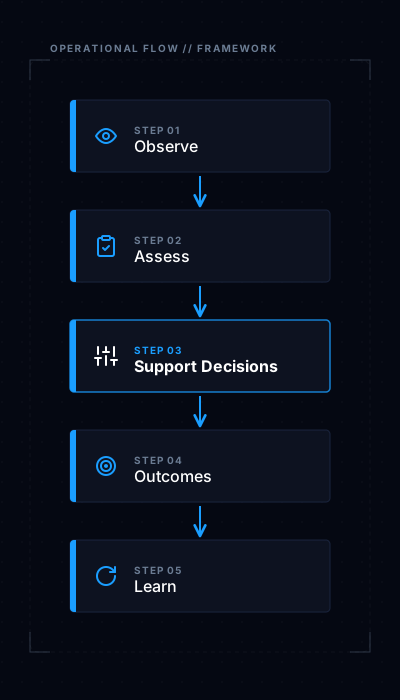
Framework — Decision Intelligence Cycle
The continuous process through which operational awareness is translated into supported decisions and organisational learning.
Observing
Effective decision support begins with observation — the continuous, structured collection of information from relevant sources. This involves understanding which information is relevant to which decisions, how different sources relate to one another, and how the significance of information changes over time and context.
Assessing
Raw information must be assessed before it can support decisions. Assessment involves contextualisation — understanding what a piece of information means in relation to the broader operational picture — and prioritisation, identifying what requires attention and what can be monitored without immediate action.
Assessment is inherently interpretive. It requires frameworks that are transparent, consistent, and auditable — so that the basis for any assessment can be examined and, where necessary, challenged.
Supporting Decisions
Decision support is not the same as decision-making. The platform presents information, assessments, and relevant context to the humans who bear responsibility for decisions. It does not make decisions on their behalf. This distinction is fundamental to the design philosophy of AstraSense and to the trust that institutional users place in the platform.
Learning Over Time
Organisations and their environments change. A decision intelligence platform that does not adapt to those changes becomes progressively less useful. AstraSense is designed to improve its relevance over time — through structured feedback, outcome tracking, and the continuous refinement of how information is assessed and presented.
The goal of decision intelligence is not to make decisions faster. It is to make them better — with greater confidence, clearer rationale, and stronger accountability.
Trust & Accountability
For a decision intelligence platform to be genuinely useful in institutional contexts, it must be trusted. Trust is not a feature that can be added to a system after the fact — it must be built into the design from the outset, through transparency, traceability, and a clear commitment to responsible operation.
Human Responsibility
Core Principle
AstraSense is designed to support human decision-makers, not to replace them. Every assessment, recommendation, and piece of contextualised information produced by the platform is presented to a human who retains full authority and accountability for the decisions that follow.
This is not a limitation of the platform — it is a deliberate design choice. In institutional contexts, accountability cannot be delegated to a system. The individuals and organisations authorised to make decisions must remain in control of those decisions, with the platform serving as a structured aid to their judgement.
- Human decision-makers retain authority and accountability at all times
- Authorised personnel determine how platform outputs are used
- Responsible use frameworks are established by the deploying organisation
- Oversight mechanisms are embedded in operational procedures, not assumed
- The platform does not act autonomously on behalf of users
Traceability
Every assessment and decision supported by the platform should be traceable to its source. Decision-makers and their organisations must be able to understand the basis on which information was presented, what sources were used, and how assessments were reached. This is not merely a technical requirement — it is a governance imperative.
In regulated environments, in public sector operations, and in any context where decisions carry legal or institutional accountability, the ability to reconstruct the information environment at the time of a decision is essential.
Transparency
Transparency in decision support means that the platform does not operate as a black box. Users should understand, at an appropriate level of detail, how the platform is presenting information and on what basis assessments are being made. This does not require disclosure of proprietary methods — it requires that the logic and limitations of the platform are communicated clearly and honestly.
Responsible Decision Support
AstraSense is designed to support responsible decision-making, not to enable the abdication of responsibility. The platform is explicit about uncertainty — it does not present assessments with false confidence, and it does not obscure the limitations of available information.
Governance Principles
The governance of data-driven decision support is an active area of policy development across government and regulatory bodies. AstraSense is designed to be compatible with emerging governance frameworks — including those relating to AI accountability, data protection, and public sector transparency — and to evolve as those frameworks develop.
Governance Commitments
- Uncertainty is surfaced, not suppressed
- Audit trails are maintained for all significant platform interactions
- Governance frameworks are embedded in platform design, not applied as afterthoughts
- Institutional users can configure the platform to reflect their own governance requirements
Use Cases
AstraSense is designed for environments where operational continuity and decision quality are critical — where the consequences of poor situational awareness or delayed response are significant. The following examples illustrate the kinds of contexts in which the platform is intended to operate.
Disaster Preparedness & Response
Emergency management agencies and civil protection organisations require the ability to maintain situational awareness across rapidly evolving events — floods, wildfires, industrial incidents — while coordinating response across multiple agencies and jurisdictions.
Critical Infrastructure Operations
Operators of energy, water, transport, and communications infrastructure face the challenge of maintaining service continuity under conditions of physical stress, cyber threat, and cascading failure. Decision support that integrates operational data with risk context is essential.
Environmental Monitoring
Organisations responsible for environmental monitoring — whether for regulatory compliance, conservation, or early warning — require platforms that can synthesise data from distributed sensor networks and surface meaningful signals from complex, noisy datasets.
Remote & Distributed Operations
Operations conducted in remote, austere, or communications-constrained environments — including offshore installations, polar research stations, and field deployments — require decision support that functions reliably under degraded conditions.
Public Sector Resilience
Government departments and public agencies responsible for service continuity, emergency planning, and cross-departmental coordination require platforms that support structured decision-making while maintaining the accountability standards required in public administration.
Research & Institutional Analysis
Research institutions and policy bodies studying complex systems — from climate adaptation to infrastructure resilience — require tools that support rigorous, traceable analysis and can communicate findings to diverse stakeholder audiences.
These use cases share common characteristics: high-stakes decisions, complex information environments, accountability requirements, and the need for operational continuity under conditions of uncertainty.
Operational Evaluation
Operational credibility is not established through design intent alone. It is earned through observation, structured assessment, and the accumulation of evidence over time. AstraSense is currently engaged in operational pilot activities intended to build this evidence base in a rigorous and transparent manner.
“Operational credibility is earned through observation and validation, not assumption.
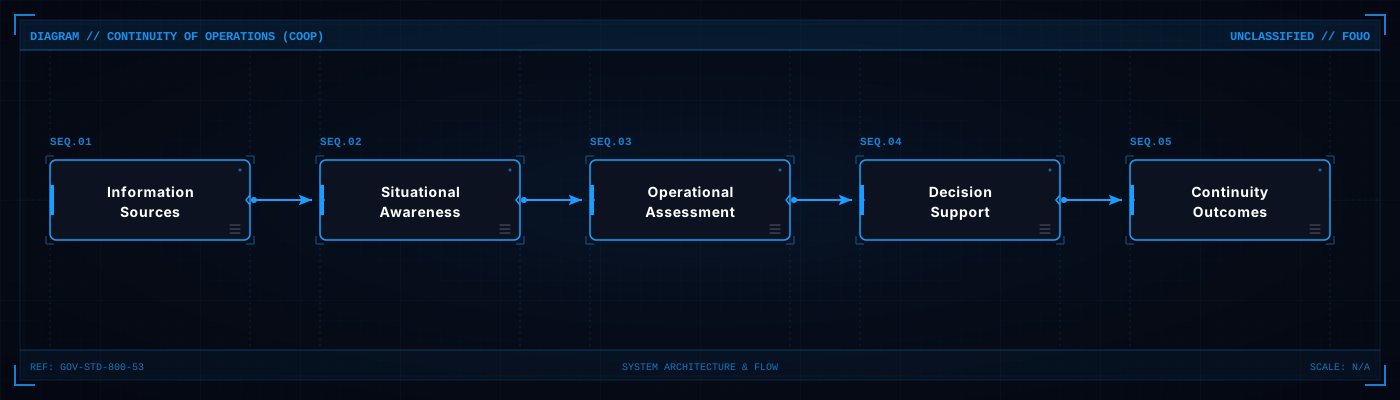
Framework — Operational Continuity Flow
How information is structured into operational awareness and translated into continuity outcomes.
Operational Observations
Pilot activities are structured to generate systematic observations about how the platform performs in representative operational contexts. These observations are recorded, reviewed, and used to inform ongoing development. No claims are made on the basis of pilot activity that have not been subject to structured review.
Assessment Validation
The assessments produced by the platform during pilot activities are evaluated against independent sources and subject matter expertise. This validation process is intended to identify gaps, inconsistencies, and areas where platform outputs require refinement before broader deployment.
Outcome Tracking
Where pilot activities involve supported decision-making, outcomes are tracked to understand the relationship between platform outputs and operational results. This tracking is conducted with appropriate governance oversight and does not involve the use of outcome data for purposes beyond evaluation.
Continuous Learning
The findings from operational evaluation are fed back into platform development through a structured process. This ensures that improvements are grounded in observed operational experience rather than theoretical assumptions.
Evidence-Based Improvement
AstraSense is committed to an evidence-based approach to platform development. Improvements are prioritised on the basis of observed operational need, validated assessment gaps, and feedback from pilot participants — not on the basis of anticipated market requirements or feature roadmaps alone.
Evaluation Principles
- Observations are recorded systematically and reviewed independently
- No performance claims are made without structured validation
- Outcome tracking is conducted under appropriate governance oversight
- Pilot findings are used to inform development, not to validate marketing positions
- Limitations identified during evaluation are disclosed, not suppressed
Future Outlook
The environments in which organisations operate are becoming more complex, more connected, and more uncertain. The trends that have driven the need for platforms like AstraSense are not abating — they are continuing to develop.
Increasingly Connected Environments
The proliferation of connected sensors, systems, and devices is creating operational environments of unprecedented complexity. The volume of data available to decision-makers will continue to grow. The challenge of synthesis and contextualisation will intensify. Platforms that can help organisations navigate this complexity will become increasingly relevant.
Autonomous and Semi-Autonomous Operations
As autonomous systems become more capable and more widely deployed — in logistics, infrastructure management, environmental monitoring, and beyond — the need for decision intelligence platforms that can interface with, supervise, and provide oversight of autonomous operations will grow. Human oversight of autonomous systems is not a transitional requirement; it is a permanent governance imperative.
Extreme and Challenging Environments
Operations in extreme environments — deep sea, high altitude, polar regions, and other challenging contexts — present particular demands on decision support. Communications constraints, physical isolation, and the absence of conventional support infrastructure require platforms that are robust, reliable, and capable of functioning under degraded conditions.
Long-Term Vision
Looking further ahead, the principles that underpin AstraSense — operational continuity, trusted decision support, and accountable governance — are relevant wherever human operations extend. As humanity considers the possibility of sustained operations in environments beyond Earth, including potential lunar and Mars surface activities, the need for platforms that can support decision-making under conditions of extreme isolation, communication delay, and environmental uncertainty will become a practical consideration.
The long-term vision for AstraSense includes the possibility of supporting operations in lunar and deep-space environments — not as a near-term deployment, but as a horizon that shapes the design principles and long-term ambitions of the platform.
This is a recognition that the challenges of decision-making under uncertainty, at distance, and in complex environments are universal — and that the principles developed for terrestrial applications have relevance far beyond them.
Conclusion
The challenges that AstraSense is designed to address are not new. Organisations have always had to make consequential decisions under conditions of uncertainty, with incomplete information, and under time pressure. What has changed is the scale, speed, and complexity of the environments in which those decisions are made.
The volume of available information has outpaced the capacity to process it. The interdependencies between systems, organisations, and environments have multiplied. The consequences of poor situational awareness or delayed response have grown. And the accountability requirements placed on decision-makers — in government, in critical infrastructure, in public services — have intensified.
AstraSense exists to help organisations meet these challenges — not by replacing human judgement, but by ensuring that the people responsible for critical decisions have access to coherent, contextualised, and trustworthy information when it matters most.
The platform is built on principles that are non-negotiable in institutional contexts: transparency, traceability, accountability, and a genuine commitment to responsible operation. These are design requirements, reflected in every aspect of how the platform is built and evaluated.
Operational credibility is being built through structured pilot activity, evidence accumulation, and continuous improvement. The platform is at an early stage of a long development journey, and the organisations that engage with it now do so as partners in that process.
“AstraSense is committed to being a trusted partner in that journey — for the organisations that rely on it today, and for the environments and challenges that lie ahead.
Download
Save or share this white paper
Open the print-optimised version to save as PDF, share with colleagues, or archive for reference.